
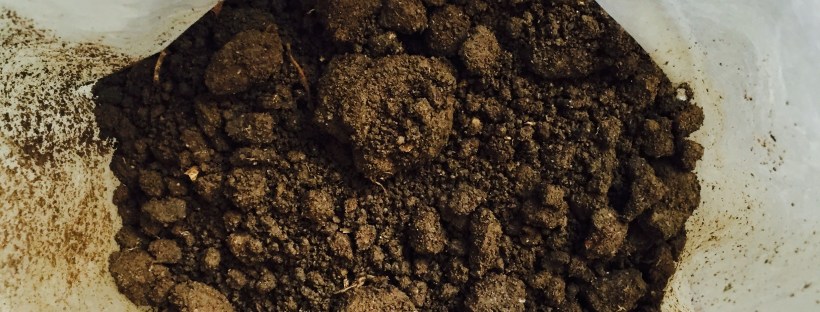
After a hectic last couple of weeks I’m happy to settle in and start a new dango. “Kingsbury” will be number six overall and the final of my California trilogy. Its soil was collected from a clay rich garden plot at my aunt and uncle’s home in the San Fernando Valley. I’m three days into the process now and so far its been a soft, spongy challenge. A dorodango is really sensitive during the early days and can only be worked for a short time before resting to dry. Here’s a quick (and dirty) run down of the first three days:
The first day is spent sifting, mixing dirt and water, and forming a palm-sized sphere. Using water and corse dirt I form a cake of mud and work with it until it’s able to hold itself together. I tend to err on the side of adding to little water and increasing slowly to get an even consistency. I passing the cake from palm to palm and start to form the sphere. Any large folds, pits, and flats are worked out and the ‘dango gets hung in a clean plastic shopping bag which will be it’s home for the next week to ten days. Hanging allows the ball to retain it’s shape and the bag keeps the dorodango surface moist as core begins to solidify. Day one ops usually take about two hours.
The most important lesson for day two is to work the ‘dango just enough to improve the shape without doing damage. The ball is still soft and does not respond well to force (do not taunt happy dirt ball). Moving the ball from hand to hand, I coat the surface with sifted dirt and focus on uniformity. Sometimes a dorodango is in really bad shape (too much water) and day two is the last chance I have to smash it and reform without losing progress. I do my best to get the sphere looking right, dust with more dirt, and bag it for another day. I tend to work for about an hour on day two.
By day three the dorodango should be drier and easier to work with. I continue smoothing and shaping carefully by hand and start working more finely sifted dirt into the surface. The last adjustments to the shape should be done now before the core is completely rigid. Any major corrections usually result in surface cracks but these can be filled by adding small amounts of water to the surface and coating evenly with dirt particles. The particles gradually lock themselves into cracks causing them to disappear. I repeat as needed until the ball is free of cracks and spherical by sight and touch. I bag it once more and allow it to rest for a day.
-

- Hopfully this will be something cool in a few days!
-
- I use a couple of different sifters to get fine and very fine particles.
-
- Water is added gradually. Proportion is measured by feel. Not too muddy, not too dry.
-

- I like to use plastic to keep initial kneading under control.
-
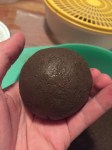
- Looks very unremarkable at this stage.
-
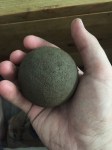
- A little more refined and a lot less wet than day two.
 Dorodango Man