
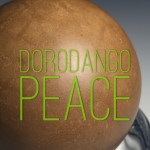
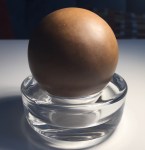
Peace is the name for this, my seventh completed dorodango. I carefully stipulate “completed” here because along the way were two failed attempts in which nearly finished dorodango were destroyed by complete fault of my own. The first shattered during its final polish and couldn’t be saved. Much like its predecessor, the second was undergoing a late stage roundness adjustment (never a good idea) when cracks suddenly appeared. The entire dorodango sheered into six pieces in my hand as I was rolling it on a smooth glass surface. I wasn’t exerting full pressure on it. Why had it broken so completely? I wondered. I saved the pieces, still spherical, tightly wrapped in a bag. As of yet I have not thought of a good way to save them and will likely return them to use as source in a future piece.
Failure is a common and frequent component of the artistic process. Rather than getting upset about the breakages or the loss of many hours of effort, I found myself caught up into why this had happened two times on the same piece and never in the previous six. My tools had changed slightly but not enough to seem significant. The force I used had been normal. I hadn’t been hurried or careless. What was different?
This dorodango is dedicated to my grandmother Nora. Her wit, honesty, unfaltering positivity, and countless individual joyous moments have been a tremendous influence to me throughout my life. Surrounded by her children, grandchildren, and friends, Nora died on June 16, 2015. In the aftermath and with the help of my family, I collected dirt from the flower bed she treasured, from her back yard where grandkids used to play, and later from her final resting place. “Peace” is the first of several I’ve committed to creating for our close family. These dorodango will serve as remembrances and a connection to the land where we used to have so many good times. Dorodango can be more than just an art object.
So, what had happened here? I’ve come to believe the significant detail is the mixture of disparate soils, mixed when wet and formed into one object then dried by gradual removal moisture, adhere more tenuously to one another than homogeneous soil. I would not be surprised if there are exceptions given the sheer variety of soil types and ratios that could be used to combine them. But, from my experience, mixing soil in this way weakens the final product. Greater care has to be taken when working with soil combinations and the finished product may have limitations to how far it can be pushed.
Armed with this idea I cracked on with number seven, take three. This ‘dango is a 50/50 mix of red clay from the grave site and dark fertile soil from her flower bed. During the process I started to notice the sponginess of the material during it’s early wet phase. I took care to get the initial shape as spherical as I could because I knew there would be no safe way to adjust it later. I noticed the slower than normal drying time. I carefully limit the pressure I used in the final stages. This time there was no breakage.
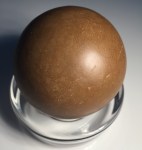
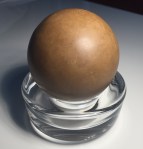
I’m pleased with how this dorodango turned out. Its final form seems to have a certain strength of character (forgive the anthropomorphism) although it lacks the high specularity of some previous pieces.
Sunday, July 26th, after nearly thirty hours of effort I was very happy to finally present “Peace” to my cousin Blake in celebration of the bond he shared with our grandmother. She will be missed.
 Dorodango Man
Thank you Dustin! This really means so much to me!
LikeLike